
Why Do Some Young Men Feel Politically Homeless?
By Abby Paterson
We are told young people are the future. But on the streets of Glasgow, many young men speak as if they’re not sure they belong in the present.
Outside a Reform UK campaign pop-up, young men pause, shrug, then speak. Their answers don’t come polished or rehearsed. They come in fragments, complaints, doubts and even contradictions.
Street interviews with young men in Glasgow.
Alex Kerr, 20, a student at Glasgow Caledonian University, said: “I voted for Reform UK. I’m fed up with the mainstream parties ... it’s like a rally against the establishment.”
What’s striking isn’t just what Kerr said, but how he said it. This isn’t enthusiasm. It’s fatigue. That distinction matters because what emerges from these conversations is not a clear shift to the right, but something more unsettled: a generation of young men who don’t feel politically at home anywhere.
“I think voting nowadays is more like you’re voting for the best of a bad bunch,” an anonymous street interviewee adds.
It’s a simple statement, one you could almost mistake as casual, but it captures a notable shift in the political landscape. For many young men, politics has become less about choosing a vision and more about managing disappointment.
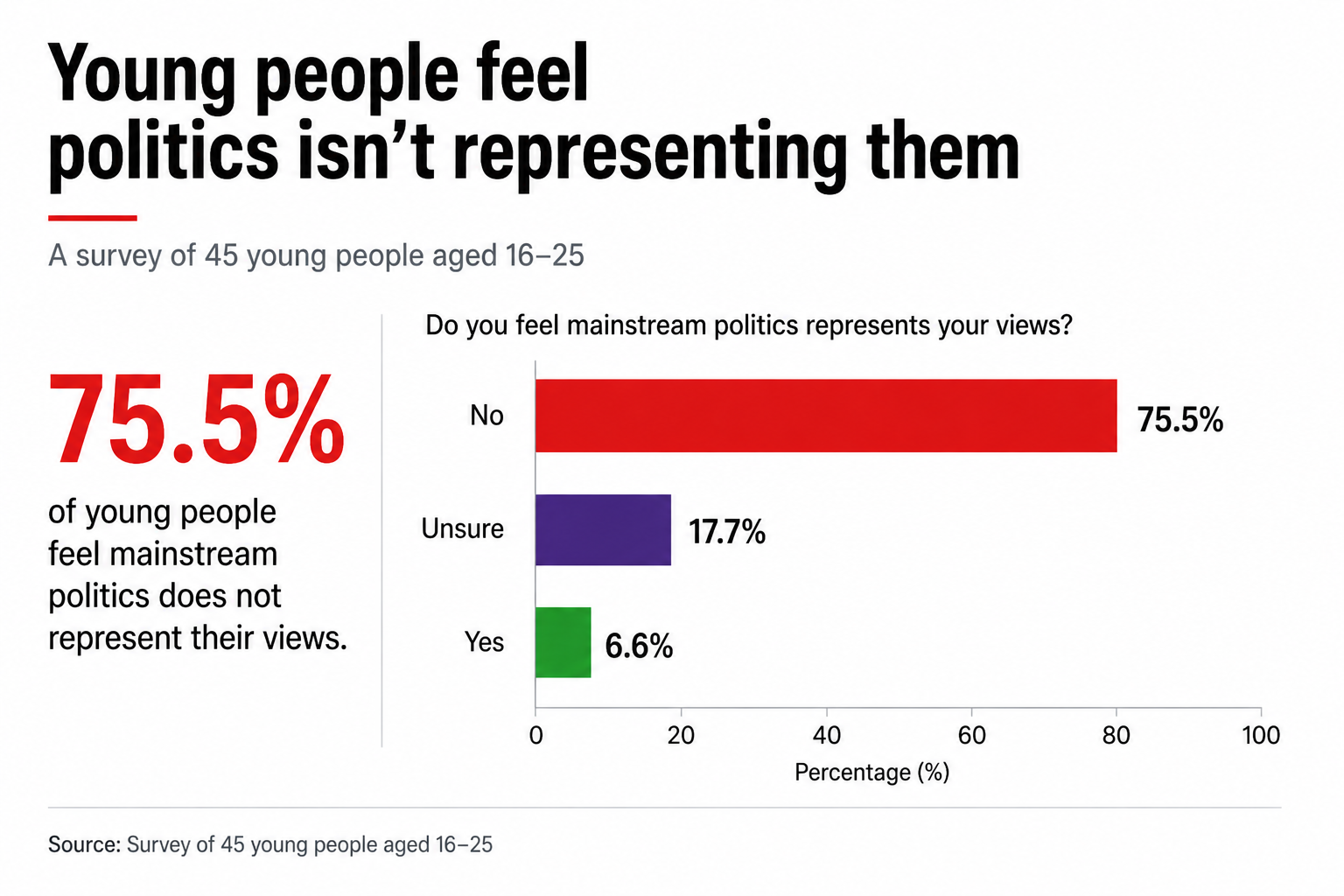
Survey results on political representation among young people
Although the sample is small and not nationally representative, it reflects wider patterns of political disengagement with only 14% of people in Britain saying they trust politicians, according to research by the Electoral Commission.
Dr Joe Greenwood-Hau, a political lecturer at the University of Glasgow, said: “People don’t trust the big, conventional, traditional mainstream parties… they don’t think they’re going to do what’s needed to actually change things.”
This growing sense of frustration towards the political establishment may help explain why some young people are turning towards alternative parties such as Reform UK, as they look for options that appear to challenge the political status quo.
Analysis by King’s College London found that 12.9% of men aged 18 to 24 voted for Reform UK in the 2024 General Election, compared to 5.9% of women, while young women were significantly more likely to support the Green Party, 19.7% compared to 13.1%.
On the surface, this shows a gender divide in voting behaviour. But it also points to something more profound. Young women are more likely to engage with politics through issue-based or progressive platforms, while some young men are instead gravitating towards parties that position themselves against the political mainstream.
This divide is not only ideological but also reflects differences in how politics is experienced among Gen Z. Data from the John Smith Centre Youth Poll 2025 shows that 26% of young men identify as right-wing, compared to 15% of women, while young women are more likely to identify as left-wing.
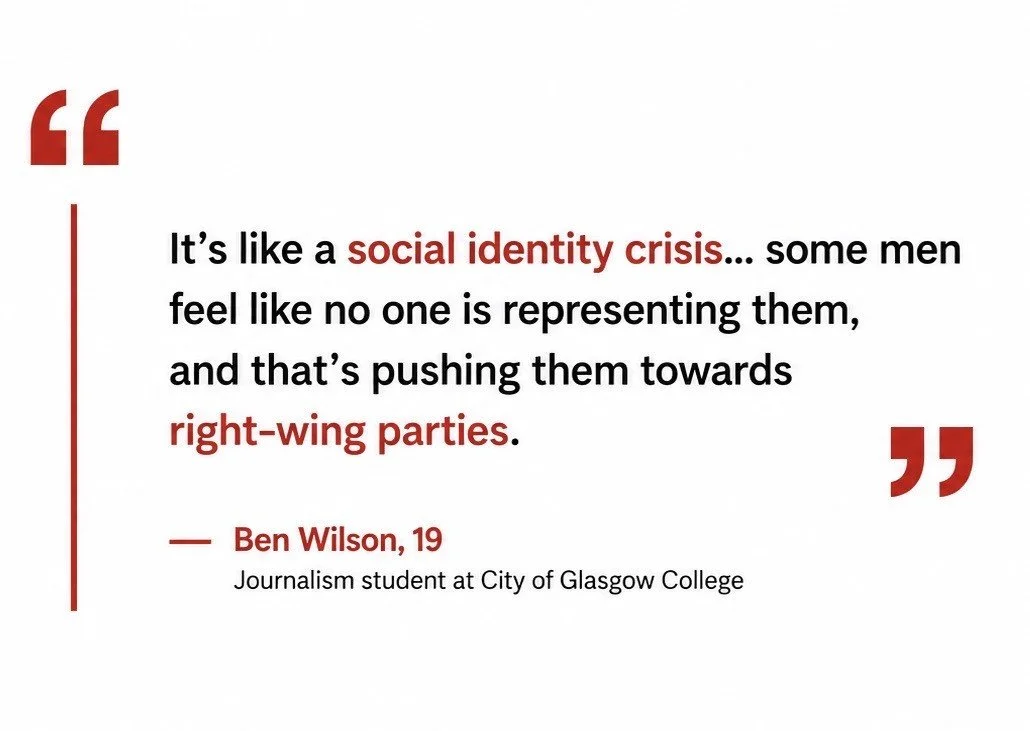
Quote from Ben Wilson
Ben Wilson, 19, a student at City of Glasgow College said: “It’s like a social identity crisis… some men feel like no one is representing them, and that’s pushing them towards right-wing parties.”
That sense of disconnection doesn’t sit neatly on its own. Politics is no longer something young people participate in at election time. For many it is becoming part of how they understand themselves. When identity and politics become interlinked, not feeling represented is no longer just a frustration, it becomes a question of belonging.
For Alex Kerr, his frustration extends beyond parties and into the way politics is communicated.
Kerr said: “The stuff produced by the parties themselves is rubbish. I don’t engage with it. It’s the content made by others, like memes or edits, that’s more effective.”
This shift is reflected more widely. Research by the National Centre for Social Research shows that around 58% of under 35s now get their political news from social media, highlighting how platforms once considered informal have become central to political understanding.
Young people are leaving behind traditional forms of political messaging: manifestos, speeches and campaigns aren’t just being rejected, they’re being replaced. Politics is now encountered through fragments on social media platforms which favour short videos, memes and edits. But if politics is increasingly consumed through content designed to engage rather than inform, what kind of political understanding is being built?
Memes don’t need to explain a political policy. They only need to feel relatable to their audience. And for young men who already feel disillusioned, that emotional immediacy can be more powerful than any manifesto.
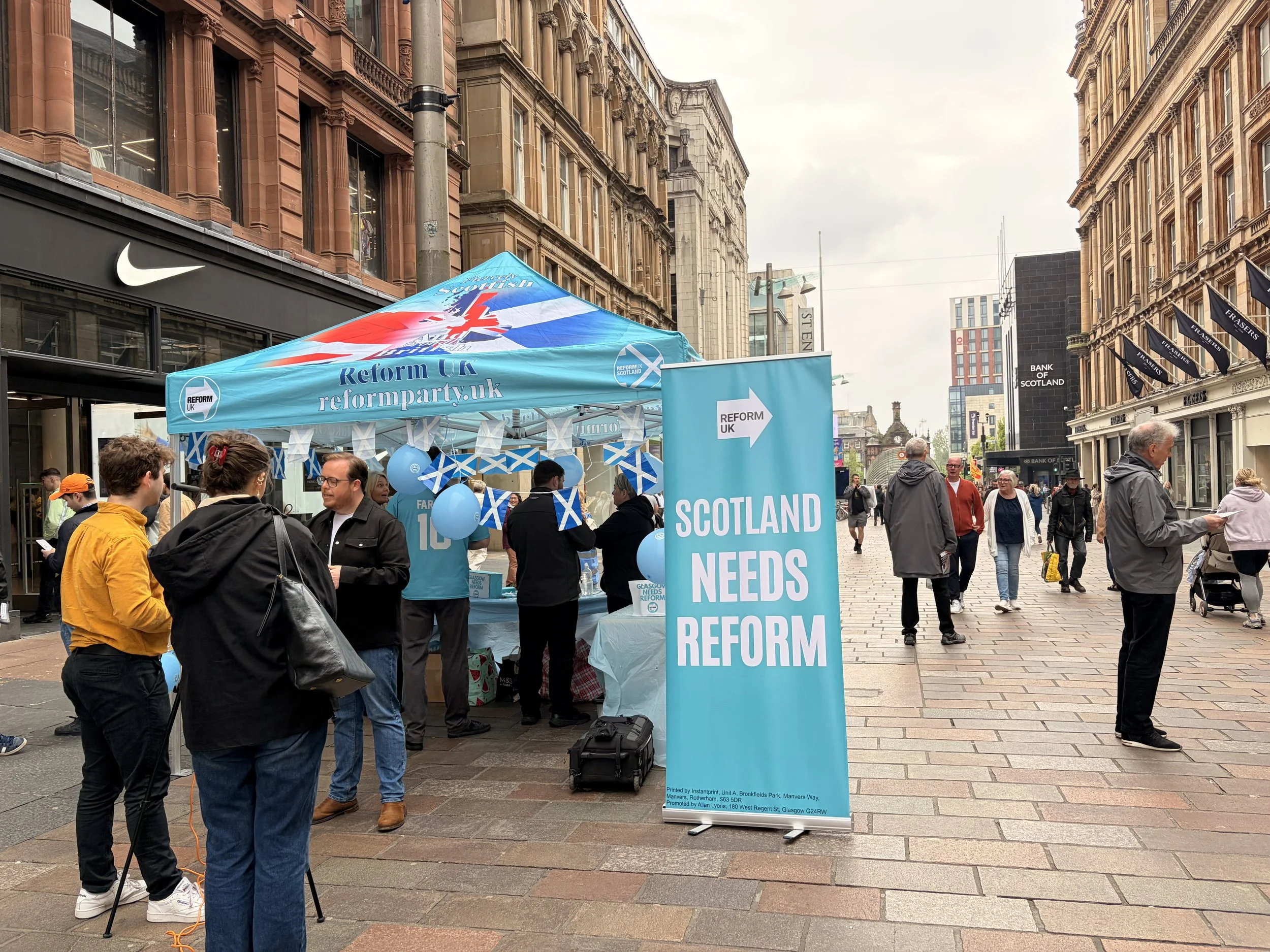
Reform UK campaign pop-up in Glasgow City Centre during an event.
Dr Greenwood-Hau said: “The environments that sustain supporters of the right can be quite porous, with potentially quite dangerous online environments.”
The concern is not just right-wing content, but the online spaces created surrounding it. Within these spaces, some young men are aligning themselves with communities that intensify feelings of political disillusionment.
Ben Wilson is also critical of the way right-wing politics frames its arguments. He said: “They take real issues, like women’s safety, and instead of addressing them, they use them to push their own agenda.”
His comment demonstrates the importance of critical thinking when it comes to politics. Rather than accepting these arguments at face value, he recognises the potential harm in how right-wing politics can reshape genuine concerns into political talking points.
Many young men are coming of age in a moment defined by instability. Economic pressures delay independence. Secure jobs feel harder to access. The future appears less predictable, less guaranteed.
Dr Greenwood-Hau expands on this. He said: “The key concerns coming out from young people are economic issues… they’re concerned about the cost of living, jobs, housing affordability, the health service, and immigration.”
For some young people this can feel politically isolating, if the issues that impact them are not being appropriately addressed. That sense of disconnect could be what drives them towards the right.
But it’s important not to oversimplify. Not all young men are moving in the same direction, at the same pace, or with the same motivations. Not all are drawn to right-wing politics. And even among those who are, the motivations are not consistent.
As Dr Greenwood-Hau said: “It’s a minority of young men who are moving in this direction. That’s not to say there’s not a risk, but there are also young men moving in the opposite direction.”
It’s important to acknowledge the potential risk posed by the rise of extreme right-wing political engagement, however it shouldn’t be overstated. Young men are not all moving towards a single destination. The reality is much more diverse.
What emerges from these conversations is a far more complicated picture than the narratives often presented around young men and the right. It would be easy to attribute this shift towards the right to social media, the cost of living or any single defining factor, but the reality is far more layered. At the heart of this reality are young men and when their perspectives are listened to rather than reduced to stereotypes, a common feeling emerges many do not feel seen or represented within politics. Whether that leads them to turn to the right, turn away, or disengage entirely, the underlying message is the same.
Until mainstream politics confronts that absence of belonging, the pattern is unlikely to change. The question is not why young men are turning to the right, but why politics has left them looking for somewhere to go at all.