
How a Crystal Almost Killed the Swiss Watch Industry.
By Nathan Devlin
During the second world war, due to Switzerland’s neutrality, watch making continued. Most other nations shifted time keeping manufacturing to timing devices to military use. As a direct result the Swiss watch industry enjoyed a boom. Prior to the 70’s the Swiss watch industry held at least 50% of the market.
In the late 50’s and 60’s Seiko in Japan and a few Swiss watch brands such as Patek Phillippe, Piaget and Omega all sought to develop quartz watches. In the early 60s a group of around 20 Swiss watch brands was established to create a Swiss quartz watch.
One of the first success stories came from Japan with a quartz clock in 1964, which was used that same year during the Olympics. Two years later Seiko and Longines releveled the first quartz pocket watch.
On Christmas day in 1969, Seiko unveiled the Astron which marked the beginning of the quartz revolution and the start of the quartz crisis in the Swiss market.
The Swiss market came back fighting, in 1972 with the univalent of the Audemars Piguet Royal Oak and designed by Gerald Genta in 1972 which introduced steel to a sports watch for the first time. It wasn’t a hit immediately but through smart marketing using the slogan; “Would you buy a Rembrandt for its canvas?”
In 1983, the crisis had reached its peak. In March of that same year the two biggest Swiss watch groups merged to save the industry, this group was named the Swatch group in 1998. It would be key in reestablishing the Swiss Market with the Swatch group being the biggest manufacturer today.
Swatch were the first to look at watches less seriously introducing colourful straps and dials that would catch your eye from across the room.
A quartz watch is powered by a small battery that sends an electrical current to a small fork shaped piece of quartz crystal, which then vibrates at around 32,000 times per second.
The use of quartz movements is not only cheaper but also highly cost effective, with Quartz watches starting around £20 and automatics around £150. The cost of maintance its significantly lower on quartz’s compared to automatics. A quartz battery can be as low as £3, a service for an automatic watch can be thousands depending on condition. However, it’s not just the price, quartz movements are highly more accurate than the standard automatics. In a month the quartz watch will typically lose or gain 10-15 seconds. In a day an automatic watch can lose or gain 10 to 20 seconds.
As of 2026, according to Market Reports World, quartz watches still hold around 70% of the market with automatics covering the other 30.
Swatch announced the Swatch X AP, Royal Pop pocket watch, again catapulting Swatch and the Swatch group back to the headlines again. They had previously held the headlines for both the Moon swatch collaboration with Omega and with Blancpain with the Fifty Fathoms.
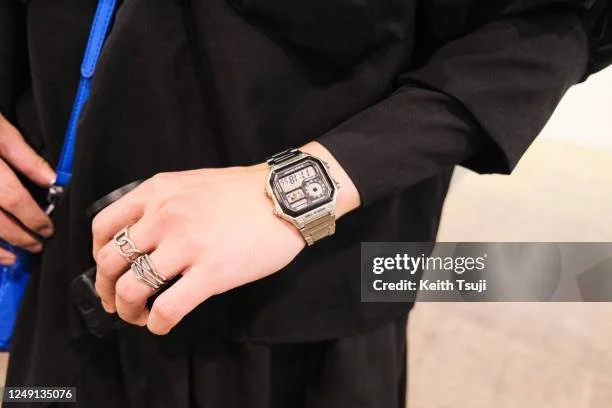
A late comer to the quartz party Casio remains one of the most popular watch brands to this day. From their small F-91W model to the C10 calculators watch to the tough G Shock. In 2025 according to Casio, they shipped over 20 million units worldwide across their range.
November is a busy month for the brand as they launch many new G Shock and normal Casio’s right in time for Christmas. For example, in 2025 they released the BX-GW-5600, which brought a MIP, LCD display to the 5600 lines for first time. Looking at this year Casio and G-Shock are introducing a whole new watch line, the 2500 series as well as a blue sapphire case DW-5600 priced at £80,000.